
By Sushil Mohta, Chairman, Merlin Group
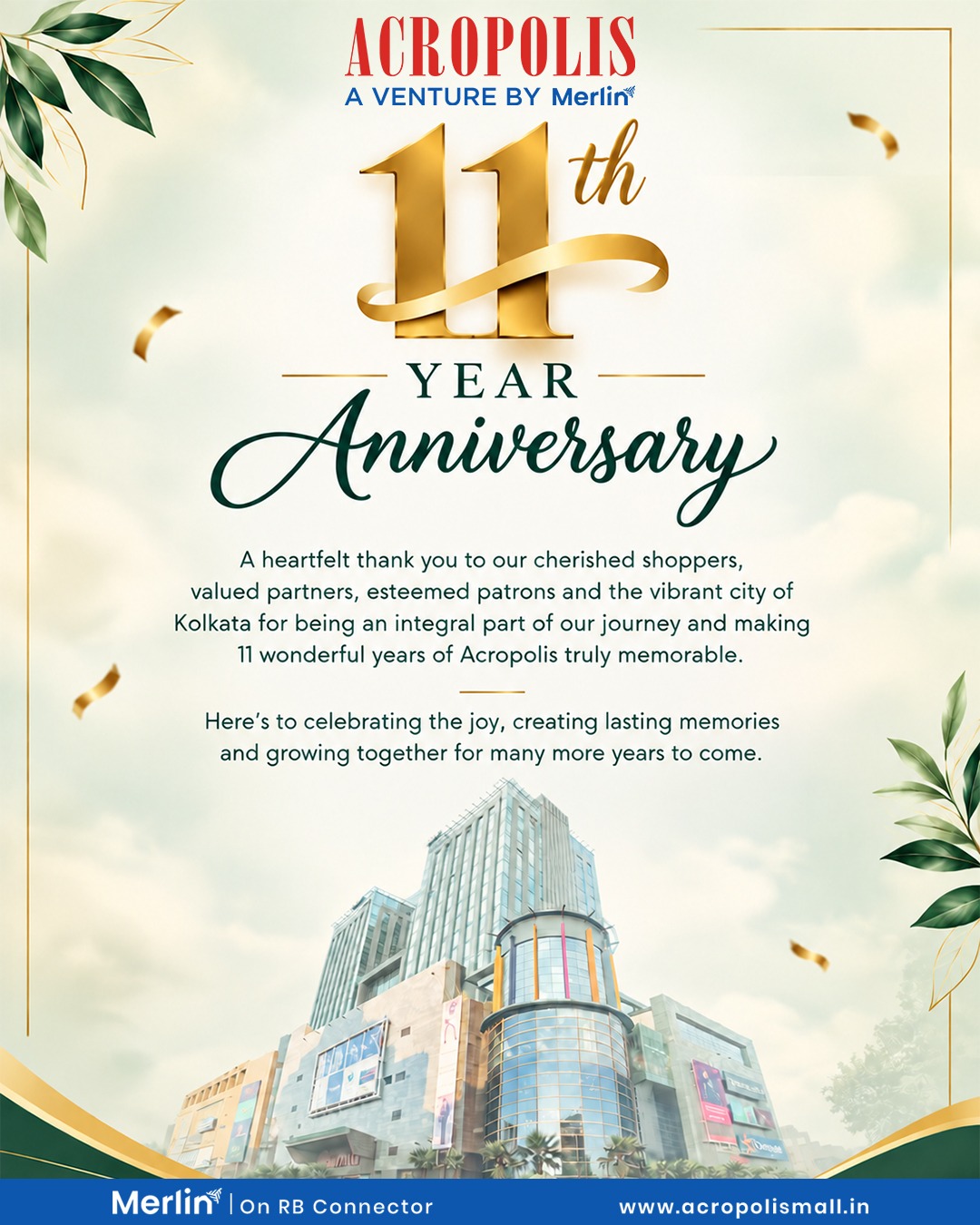
On September 25, 2015, Acropolis opened its doors to the people of Kolkata. Eleven years later, when I look back, I see much more than the growth of a mall. I see the transformation of an entire part of the city.
From a sleepy suburb to a vibrant locality
When we chose the Rashbehari Connector, few people saw its potential. It was a sleepy suburb with little significance on the city’s map. People passed through it; they did not come to it.
Today, the crossing of the Rashbehari Connector and the EM Bypass has become the nerve centre of a 10 km circle in South Kolkata. I like to call it the New Esplanade of Kolkata. Just as Esplanade was once the place where the whole city met, this junction has become the natural meeting point for lakhs of families living around it.
Around Acropolis, a new neighbourhood has come alive. In the last few years, we have seen new food and beverage outlets, retail stores, hotels, offices, commercial establishments and residential complexes emerge all around. Real estate values in the area have grown manifold. A well-planned destination does not just serve a locality — it creates one.
Why Kolkata needs a place to meet
Our weather tells an honest story. We have about four months of monsoon rain and four months of extreme heat. For most of the year, the outdoors are simply not friendly for people to meet and spend time together. Our parks and public spaces, however much we love them, cannot always serve that purpose.
This is where Acropolis has found its true role. A cool, comfortable, neat and clean environment makes the mall work like a public park for the city — a place where people can meet and greet, where grandparents walk with grandchildren, where friends catch up over coffee, and where families spend an evening together, rain or shine.
What has changed since 2015
In 2015, people came to a mall mainly to shop. Online shopping was still young, and finding big national and international brands under one roof was itself the attraction.
Today, a customer may discover a product on Instagram, compare prices online, and then come to Acropolis to see, touch and try it before buying. On another day, the same person may come with no shopping list at all — just to watch a film, meet friends or have dinner with the family.
The pandemic reminded all of us how much we value being together. A smartphone can deliver convenience, but it cannot deliver the experience of being there.
Our retail mix has grown along with our customers — from a largely fashion-led mall to one that houses fashion, beauty, technology, jewellery and lifestyle brands, including Decathlon, Adidas, Forest Essentials, Nykaa, Apple and Indian Silk House, among many others.
The fundamentals remain the same
When we conceived Acropolis, our vision was to create much more than a shopping centre — a destination where people could shop, work, dine and spend time together. That philosophy has not changed in eleven years. What has changed is the customer, and the city around us.
E-commerce has not made the mall redundant. It has made the mall more human. Physical retail today must offer what a screen cannot: experience, discovery, human interaction and a sense of community.
Acropolis began as a mall. Eleven years later, it has become a landmark, a meeting place, and the heart of a new South Kolkata.